Tuesday, August 21, 2007

FARM BOYS LIVE AMERICAN DREAM


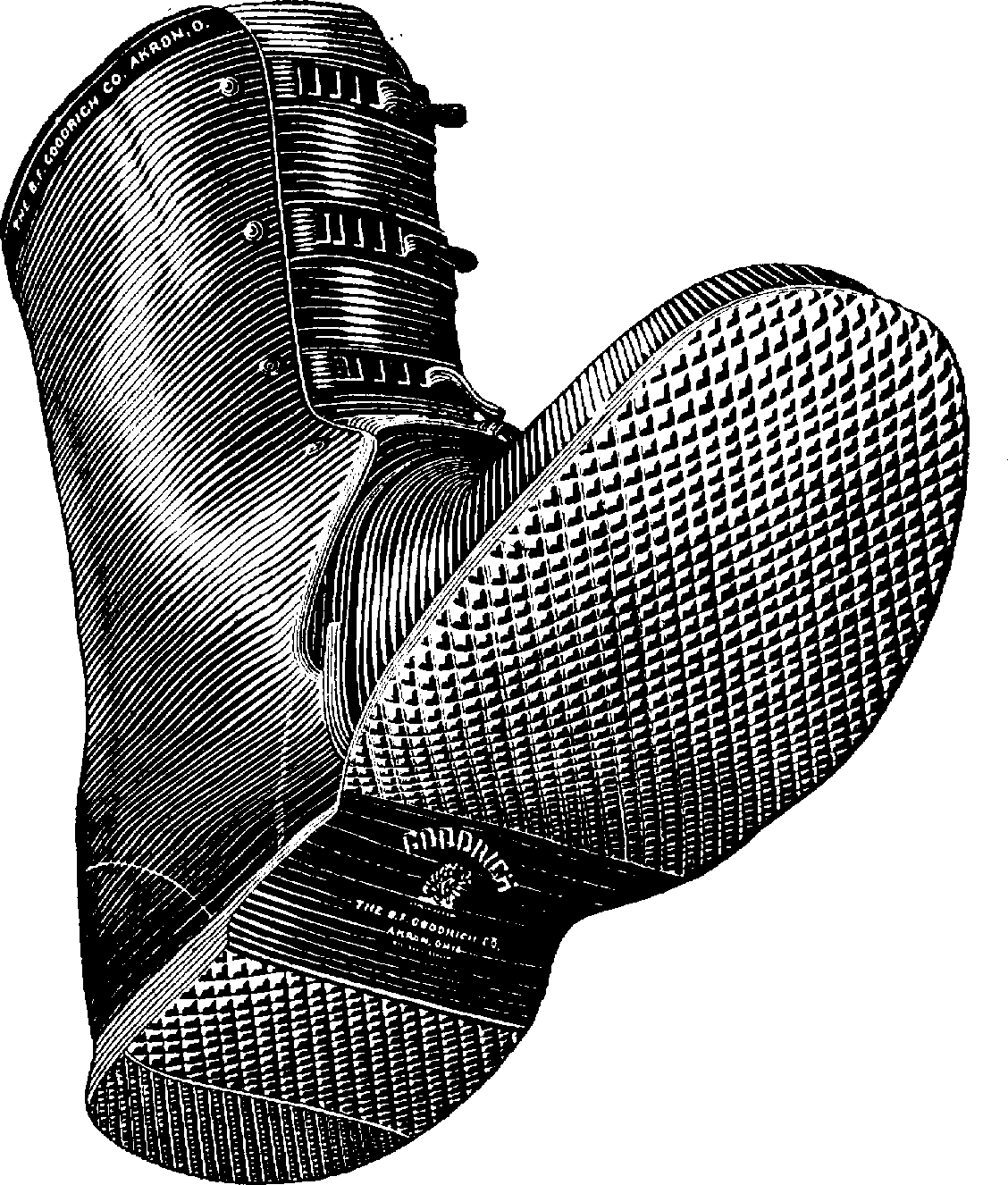
The Big Boot: College degree is now more important than experience and integrity.


During my later working years, some of my fellow workers and I often discussed, and sometimes joked about, our “degree of obsolescence." We considered ourselves "dinosaurs just waiting for the Ice Age." We all felt certain that we would be the last non-college-trained people to hold our positions, or jobs of a similar grade level.
Most of us had the same background. We were farm boys who had "worked our way up through the ranks." We had all slogged through the mud and heat
detasseling corn. We had shoveled tons of ear corn, processed, and piled warehouses full of bagged seed corn back in the days when forklifts were
still unheard of. And we'd driven trucks over many miles of roads, both paved and unpaved, to deliver our finished product to farmer dealers. Our job qualifications consisted mostly of experience, integrity, the willingness to take on a job, and the ability to get it done."
My younger friends, all insisted that I was the "lucky one." Being the oldest of the group, they always assured me that I would make
retirement before the ax would' drop. In the future we could see nothing but changes, mergers, downsizing, and the dropping of our beloved old "Pride" trademark.
A few of the younger fellows are still working for our parent company. Quite a few of the rest of us were fortunate enough to stay with that company until retirement. And, I'm happy to say, most of those who didn't, landed on their feet and found jobs as good or better with other employers.
I've crossed paths with quite a few unhappy people, though, who were terminated or forced to take early retirement long before they were prepared to face it. For some, this is often a crushing blow financially or to their self-esteem, or both.

THE BIG BOOT.

His boss said, "Duke,
I know I'll miss
'You, but time must move on.
What I mean is .
You're out of here .
We've downsized, Duke, you're gone!"

Poor old Duke's head
Began to spin;
His mind was in a fog.
He couldn't help
But feel that he'd
Been treated like a dog.

The loyalty
He'd given to
His employers, and boss –
Forgotten now –
The book showed Duke
As not "profit, "but "loss.”

He'd done his best,
Worked hard and dreamed
America's Great Dream,
But now he found.
His paycheck gone,
Worse yet, his self-esteem.

The promises,
The pension plan,
Were more things sure to go?
Dreams of happy .
Retirement, now,
Something he'd never know.

Duke thought, "I guess
Life ain't quite fair.
No matter where you're at.
There's always some
Guy primed to kick
You when you're down and flat.

"I've slaved and worked,
My poor fingers
Down to the bone, and yet,
Now too old to
Dig ditches, that's
The one job I can get!”

Perhaps old Pap
Was right when he
Told young Duke, years ago,
"Always guard well
Your backside. Be
Alert. Watch where you go.

"And turning 'round
Too quick’s much like
The flipping of a coin.
That big boot aimed
At your backside.
Will nail you in the groin!"

Tuesday, August 14, 2007

LIVING WITH CREEP, CRAWLY SPIDERS

ARACHNIDS: The black widow and brown recluse have a dangerous bite.
Spiders have never been my favorite kind of bug. They are sort of messy critters, I dislike walking through spider webs. And, as youngsters, a lot of us were taught to avoid the little rascals, as some were believed to be poisonous. Especially the large, colorful ones that we often saw in the gardens.
Somewhere along the way, I've been informed that, technically, spiders are arachnids and are not to be referred to as "insects" or "bugs." That they have eight walking legs instead of six. And they have two feelers and two poison fangs. I've never really been interested enough to inspect them carefully.
My "bug expert" friends tell me that spiders are strictly carnivores, that they eat only living prey that they capture. And that they are not equipped to handle solid food in their stomachs, so they must digest it outside their bodies. Crushing their victims, often injecting them with poisonous venom, and then ingesting the resulting liquid is their way of feeding.
There are many thousands of species of spiders scattered over most of the world. A few even live in the water. Their basic design seems to have been very successful, judging by the large population and the way that they are distributed. We find them almost everywhere, in the woods, the fields, the lawns, our homes and especially our garages. Most species are harmless to humans, but the black widow and the brown recluse are considered dangerous, as they are capable of inflicting bites that quite often require immediate medical attention. Such bits are usually very painful and, in certain cases, can even result in death.
Spiders don't appear to be very sociable animals, and seem to prefer to be left alone. An individual seeks out a corner or area where it doesn't expect to be interfered with, and where there appears to be a ready, steady food supply. There the arachnid begins the tedious task of constructing its home. It actually creates a small world of its own. A world built of silk. Fine silk with more flexibility and tensile strength than steel. A spider's carefully woven web furnishes its weaver with safety and isolation, much as does a moat around a castle. Anything touching the sticky network creates vibrations, an advance warning system that alerts the architect and builder of possible impending danger.
The intricately crafted spider's web also is a device for trapping its food. A fly or other insect, on contacting the sticky threads, is soon hopelessly entangled in the filmy mesh. The hunter, alerted by the vibrations, then comes out to harvest, and to feed on its victim.
A "lifeline" of silk can enable a spider to lower itself from a ceiling, or catch itself in a fall. And, in some cases, is used as a sail, allowing its spinner to travel long distances by "riding the wind." A single strand is said to be strong enough to stop a honeybee flying at full speed. And it is said that, in theory, a cable of spider web as thick as a pencil would be able to stop a Boeing 747 in mid-flight!
I remember times when our dairy barns were not whitewashed and sanitary as the are today. In cases where de-horning or other animal surgery resulted in excessive bleeding, one of the more common home remedies was to apply a large handful of dusty spider webs (which were usually plentiful). The "theory" was that the strong fibers formed matting that slowed the blood flow, giving it a better opportunity to begin clotting. And, believe it or not, the treatment usually seemed to work!

SILKEN STRUCTURE


Dew drops, jeweled
By morning sun,
Light up the web
My spider's spun.

Graceful thin lace,
A beauteous thing,
More flimsy than
Gossamer wing,

Silk threads stitched in
Dainty design
That put to shame
Artworks of mine.

Once this spider
Traveled alone,
Destined to face
Life on its own,

Its first need was
A home, of course.
The second, a
Ready food source.

It had no wood,
Nail, hinge, or pin,
Just its own silk
That it could spin.

The spider knew
It must proceed
To weave a web
That filled each need.

Between window
And stairway brace
It filled up its
Allotted space

With a design
That proved good sense,
Both food trap and
Line of defense,

Welcome thrill to
Artistic eye,
But killing field
For careless fly.

Monday, August 13, 2007

AND THE RAINS CAME


After long months with no rain
on either foothills and plain,
storm clouds closed in
on our tiny town.

Bright lightning and loud thunder
ripped the wild skies asunder,
heaven's blessing soon
were pouring down.

A preacher, both old and wise,
smiled up at the stormy skies,
said, "Last Sunday we
all prayed for rain.


"We know the Lord's at our side
and He will always provide.
Our fervent pleas
were not made in vain."


An elderly native chief
clinging to an ancient belief,
proudly says, "Each time
these big rains come,


"it's by the Great Spirit's grace.
For this, I painted my face,
danced the rain dance,
and beat on my drum."


After thinking for a spell,
one wise old ne'er-do-well
said, "I'm not one to
trouble my brain.


"Why should we get all upset?
Why not just take what we get?
Long dry spells always
end with some rain."

Tuesday, August 7, 2007

HANDYMEN ARE A DYING BREED


Almost everyone seems to have some special talent. The ability to handle one particular job or activity much better than average. With some, it is athletic ability, or musical or acting talent. And others are so good at parenting that they seem to have been born just to bear and raise children.
And then there are the mechanically inclined. Those who can use their talented hands, eyes, ears, and minds to seek out and solve problems that occur with automobiles, machinery, tools, appliances, and most or all other the other artifacts that make us such a large part of our daily lives.
The old-times said that it took a special talent to "time" a grain binder. When operating properly, the machine not only cut the grain plants off above the ground, but also "packaged" the crop in bundles, neatly tied with twine - bundles that workers could stand up in "shocks" to cure in the field. A binder that left a lot of untied bundles was a major aggravation that could be quickly remedied only be someone who "had the knack."
In more recent years, even today, twine-tie hay balers still uses basically the same knotter mechanism that the old binders did, often giving the same problems and requiring the same tender loving care from one of the few people qualified to make the proper adjustments to solve such problems.
I remember a few itinerants who used to travel around the territory sharpening knives and saws and scissors. Some of these carried along a blow torch and soldering irons so they could repair leaking milk pails and cans, also kitchen pots and pans. And on rare occasions, during the Prohibition fiasco, they were known to solder up leaks in the copper equipment of a few of the local moonshiners' illegal stills.
Some towns were fortunate enough to have a "fix-it shop" where people could take their small equipment for repairs. If memory serves me correctly, even TV's Mayberry had such an establishment. As electrical power became common, there soon were toasters, fans and other small electrical appliances that were in frequent need of repair,adjustment, or new cords or plugs.
And then things changed. Much of the equipment we use today is not designed to be repaired. Most of it is too computerized and complicated to be repaired by anyone who is not properly equipped and frequently re-trained. And it becomes more and more tempting to purchase a new Taiwan-made replacement. So, one-by-one, I fear we will be saying good-bye to our few remaining friendly fix-it-shop operators and shade tree mechanics.

MR. FIXIT

Old Andy, the handyman,
Does the best job he can
In his shop on the cobblestone street.

He repairs old wheelbarrows,
Builds traps to catch sparrows,
And half-soles shoes for numerous feet.

He solders leaky old pails,
And with glue, screws and nails
Can fix anything made out of wood.

Can fine-tune a lawnmower;
Fix a sick snow blower
So it slings slushy snow as it should.

He can oil up old leather,
Long exposed to weather,
Till it's supple and soft, just like new.

He'll fix a bicycle brake,
And, in a jiffy, make
Most machines do what they're built to do.

He seldom will question why,
But most jobs he'll just try,
Though some may seem quite trifling and small.

He can install a new latch,
And even re-attach
The arm of a small sobbing child's doll.

At times, he's re-glued old books,
Sharpened dull fishing hooks,
Once re-wove my old trout-fishing creel.

The last of a dying breed
He's filled many a need
Helped keep many lives on even keel.

As his steps now grow more slow,
Seems the townsfolk all know
Time will soon come for him to move on.

His loss we surely will feel.
We all wonder how we'll
Get on without Andy when he's gone.

Sunday, August 5, 2007

PEOPLE OFTEN MAKE THEIR OWN LUCK


Persistence: It's natural to focus on bad breaks, but it shouldn't prevent us from giving it the old college try.
Only too often, I hear people use the expression, "But with my luck..."
"But with my luck, things won't go that way." "But with my luck, it will rain." "But with my luck, I can't help but fail." Occasionally, I find myself using that expression. And that can be a bad habit to get into.
Most of our good fortune doesn't just fall into our laps. Oh, sure, now and then someone wins the lottery or unexpectedly inherits a large wad of money, or even comes out on the long end at one of the local gambling casinos. But such occasions are rare. These are definitely the exceptions to the rule.
Usually, success and happiness begin with thoughts and daydreams, which we build into plans and schemes. As we build these "air castles," we often begin to foresee various problems that could arise should we begin building the real structure." We would be foolish not to look for such snags and begin thinking about solutions for them, should they arise. But if we are too easily discouraged and consider these problems as barriers to our progress, and as insurmountable, we will most likely let our golden dreams fall to the ground.
It's so much better to keep the dream alive. To keep the faith. And to keep our eyes open. A successful baseball batter doesn't just close his eyes and swing, but follows the pitch all the way in to the plate. If we see potential problems in our future, and consider them as challenges rather than roadblocks, we often can find solutions for them.
Thomas Edison's idea for the incandescent light bulb was a great one. Something that could benefit all of mankind for many generations. But its success depended on its inventor's persistence. He was forced to try almost every imaginable material before he found one that did not burn out immediately. But he did not consider these attempts as failures. He listed each as a success. With each burned-out bulb, he felt that he had successfully proven one more material as being unacceptable. And he continued looking for the one that was. He remained in the laboratory and created his own "luck."
One old fellow I know doesn't care too much for listening to others' sad tales and sob stories. Or hearing them tell about the negative things that are certain to happen "with their luck." His usual reply is ungrammatical, but short and to the point: " Them's the breaks."